
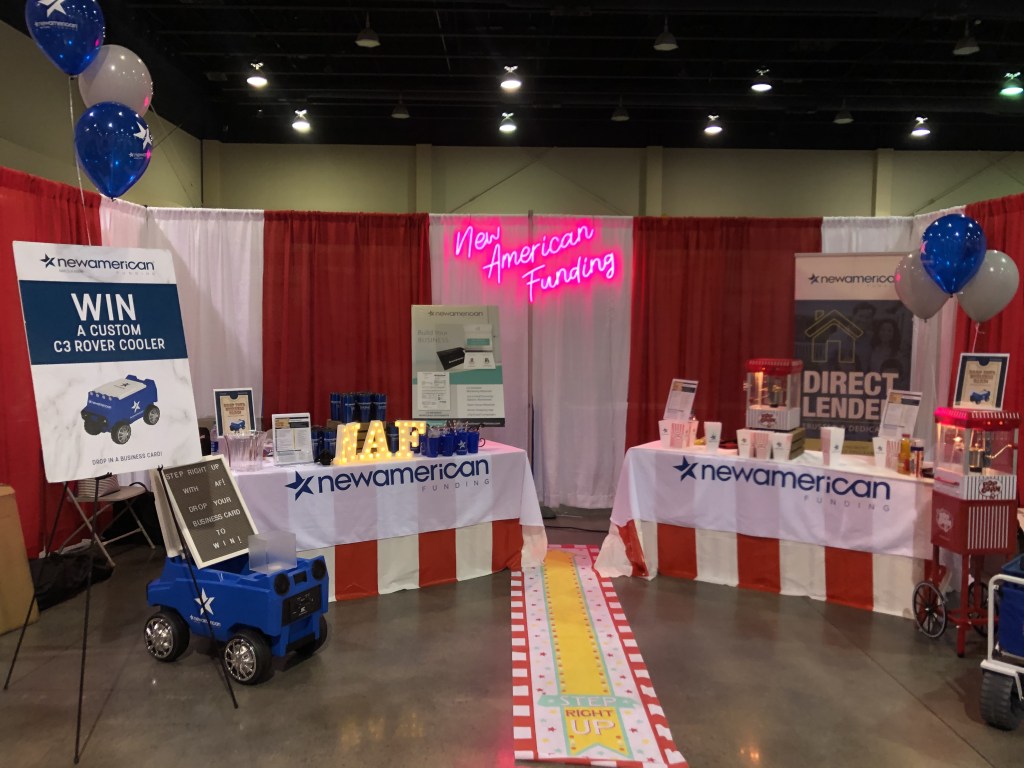
When you think about a tradeshow booth, it’s easy to focus on the logistics.
Is the booth shipped?
Is the signage correct?
Did the promotional items arrive?
Is the lead scanner working?
Are the graphics installed?
Does everyone know where they need to be and when?
All of those things matter. A lot!
But once the booth is built and the logistics are handled, there’s a bigger question every event marketer should be asking:
What is actually going to happen at the booth — and beyond?
Because having a beautiful booth doesn’t automatically create a meaningful event experience.
And putting your logo on a backdrop or having cool promotional items on the table doesn’t automatically give someone a reason to stop.
Think about it.
Most companies at a tradeshow have some version of the same setup.
A booth.
A backdrop.
Branded graphics.
Promotional items.
Lead scanners.
Maybe a giveaway.
So what is going to make your booth stand out among all the others?
What is going to make an attendee stop?
And once they stop, what is going to make them stay?
What is going to make them engage with your team, have a real conversation and become invested enough to potentially have that sales conversation you’ve been working so hard to earn?
That’s where the real event marketing begins.
Let’s dive in.
Your Website Already Does a Lot of the Talking
Think about how much information a potential customer can find before they ever step foot into your booth.
They can read about your products.
They can watch videos.
They can download a brochure.
They can read customer testimonials.
They can compare features.
They can request a demo.
They can learn about your company, your leadership team and your solutions.
So when someone walks up to your booth, handing them a brochure and repeating what’s already on your website isn’t necessarily adding value.
They didn’t come to the tradeshow to read your website in person.
They came for something different.
They came to see.
To experience.
To ask questions.
To meet people.
To have conversations.
And potentially to discover something they didn’t know they needed.
That’s where the real opportunity exists.
Give Them a Reason to Stop
Before you start thinking about giveaways, games or elaborate booth activations, ask yourself a simple question:
Why would I stop here?
If the answer is simply “because they have a cool booth,” that’s probably not enough.
Your booth should communicate something that makes an attendee curious.
Maybe there’s a question on your signage that speaks directly to a problem your audience is experiencing.
Maybe you’re demonstrating something live.
Maybe you’re offering a quick assessment.
Maybe there’s an expert on your team who can answer questions attendees actually care about.
Maybe you’re showcasing a customer story that makes people think, “Wait… we have that same problem.”
The point is to create a reason to stop that goes beyond the logo.
Because attention is the first step.
It’s not the finish line.
Then Give Them a Reason to Stay
Getting someone to stop is great.
But now what?
This is where the people working the booth become just as important as the booth itself.
A beautiful exhibit can attract attention, but people create the experience.
If an attendee walks up and the first thing they hear is:
“Can I scan you?”
You’ve probably lost some of the opportunity.
Instead, start a conversation.
Ask what brought them to the show.
Ask what they’re currently working on.
Ask what challenges they’re facing.
Ask what they were hoping to learn at the event.
And then listen.
You might learn that the person standing in front of you isn’t interested in the product you expected them to be interested in.
That’s okay.
Because you’re learning something about your customer.
And that information can be just as valuable as the lead itself.
Personal Conversations Are the Competitive Advantage
Here’s something your website can’t do.
Have a conversation.
Your website can tell someone what your company does.
Your sales deck can tell them why your product is different.
Your marketing materials can explain your features and benefits.
But a person can listen to an attendee describe a problem and say:
“We’ve actually seen that before.”
That’s different.
It’s personal.
It’s relevant.
And it can create a level of trust that a marketing asset can’t replicate.
This is why booth staff shouldn’t simply be there to hand out swag and scan badges.
They should be prepared to talk to people.
And not just talk.
Listen.
Engagement Doesn’t Have to Mean a Game
Let’s talk about giveaways.
I love a good giveaway!
But a giveaway isn’t an engagement strategy.
It’s an attraction strategy.
There’s a difference.
Someone stopping by your booth to grab a branded water bottle doesn’t necessarily mean they are interested in your company.
And there’s nothing wrong with that.
But if your goal is pipeline, you need to think beyond the giveaway.
What happens after they pick up the swag?
Do they have a conversation?
Do they see a demonstration?
Do they meet someone from your team?
Do they learn something?
Do they have a reason to come back?
Do they leave with a better understanding of your solution?
That’s engagement.
The giveaway might get them there.
The experience is what keeps them there.
Your Booth Staff Can Make or Break the Experience
This is an area that deserves much more attention than it usually gets.
You can spend hundreds of thousands of dollars on an event and still have a disappointing outcome if the people working the booth aren’t prepared.
Your team needs to know more than the event schedule.
They need to understand:
- Who are we trying to reach?
- What problems are these attendees experiencing?
- What questions should we be asking?
- What should we listen for?
- What makes our solution different?
- What stories can we share?
- What qualifies as a strong lead?
- How should we document the conversation?
- And what happens after the show?
Because the event doesn’t end when the attendee walks away.
The Experience Continues After the Booth
This is the “and beyond” part.
Let’s say you had an incredible conversation with someone at your booth.
You learned about their challenges.
You showed them how your solution could help.
They were genuinely interested.
They scanned their badge.
Great.
Now what?
If the lead sits in your CRM for three weeks before someone follows up, the great booth experience you created starts to lose its value.
Your event experience should have a clear path from:
Attraction → Engagement → Conversation → Lead → Follow-Up
The booth is only one part of that journey.
Your pre-event marketing creates awareness.
Your booth creates the in-person experience.
Your team creates the relationship.
Your follow-up keeps the conversation going.
And your sales team ultimately has the opportunity to turn that relationship into revenue.
That’s event marketing.
Stop Measuring Success by Foot Traffic Alone
A crowded booth looks great.
It photographs well.
It makes everyone feel like the event is going well.
But a crowded booth doesn’t automatically equal a successful event.
I’d rather have 20 meaningful conversations than 200 people grabbing swag and walking away.
Of course, we should still measure the numbers:
- Booth traffic
- Leads captured
- Meetings booked
- Qualified leads
- Pipeline generated
- Engagement
- Follow-up activity
- Revenue influenced
But don’t forget the qualitative information.
What were people asking?
What problems kept coming up?
What objections did you hear?
What did attendees seem most interested in?
What surprised your team?
What did you learn about the market?
That information can influence your marketing long after the booth is packed up.
The Logistics Get You There. The Experience Makes It Matter.
Getting the booth to the show is the logistics.
Building the booth is the logistics.
Shipping the swag is the logistics.
Setting up the lead retrieval system is the logistics.
Making sure everyone knows where they’re supposed to be is the logistics.
But what happens once the attendee walks up?
That’s the experience.
And the experience is where event marketers have an opportunity to differentiate themselves.
Your booth doesn’t have to be the biggest.
It doesn’t have to have the most expensive giveaway.
It doesn’t need the most elaborate activation.
It needs a reason to stop.
A reason to stay.
A reason to engage.
And ultimately, a reason to continue the conversation after the event.
Because your website can tell them what you do.
Your marketing can tell them why you’re different.
But your event gives you something neither of those can fully replicate:
The opportunity to connect with a real person, have a real conversation and create an experience they’ll remember.
And that might be the most valuable thing you bring to the show.
So before your next tradeshow, don’t just ask:
“Is everything ready for the booth?”
Ask:
“What are we going to do once they get there?”
That’s the question that can turn a booth into an experience — and an experience into an opportunity!
So, how are you extending the event experience beyond your booth?
Need Help Going Beyond the Booth?
Your event shouldn’t be successful simply because the booth showed up on time.
It should be successful because you had a strategy for getting people there, engaging them once they arrived, creating meaningful conversations, and turning those conversations into opportunities.
That’s where I come in.
With over a decade of experience in corporate events and event marketing, I help businesses plan and execute events with the strategy behind the logistics — from trade shows and conferences to partner events and customer experiences.
Need help making your next event work harder for your business?
Let’s talk about what you’re planning and where I can help.
I Plan It. You Host It!
Visit www.tiffaniemishelleweddings.com to learn more or email info@tiffaniemishelleweddings.com.
See you Behind the Event,
Tiff
 Behind The Event...
Leave a comment